

Energy Efficiency in a High Demand Era: Why It Matters Now
Kelly Stallard, Vice President – Business Development and Partnerships
Energy efficiency has long been recognized as a cost effective way to reduce energy use. What has changed is the context. Electricity demand is rising at a pace not seen in decades, driven by electrification, extreme weather, and the rapid expansion of data centers and AI‑enabled digital infrastructure. At the same time, rising energy bills are becoming a growing source of financial stress for many households. In this landscape, energy efficiency has moved from the margins to the center of the energy conversation.
Recent consumer data collected by the American Customer Satisfaction Index (ACSI®) reflects this shift clearly. As households navigate higher monthly energy bills and a more complex energy landscape, their attitudes toward energy efficiency are evolving. What was once viewed primarily as an environmental or optional upgrade is increasingly understood as a practical way to manage costs, improve comfort, and regain a sense of control over energy use.
At the same time, these individual decisions are taking on broader significance. As electricity demand accelerates and grid pressures grow, the same programs consumers rely on to lower their bills are emerging as essential tools for utilities and states seeking to balance affordability, reliability, and long‑term system planning. The data shows that customer behavior and system needs are beginning to converge.
Energy Efficiency Is Already Part of Everyday Life

More than half of consumers say they already participate in some type of energy efficiency program. This level of adoption signals that efficiency is no longer a niche or experimental offering, it’s become a mainstream tool that many households rely on to manage energy use, costs, and comfort.
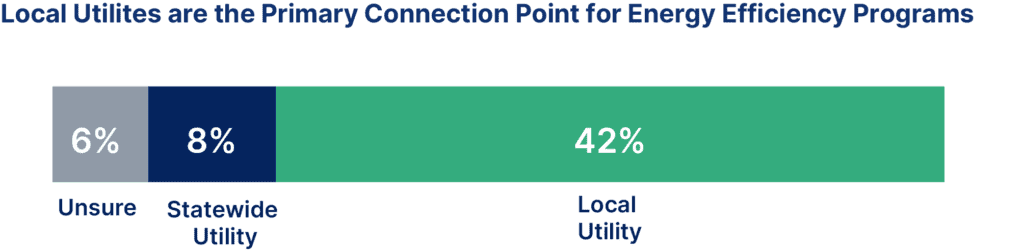
Participation also tends to happen through familiar channels. Local utilities account for the largest share of engagement, underscoring their role as a key link between customers and solutions. As efficiency becomes more central to system planning, that trusted relationship grows in importance.
Affordability Is the Primary Driver and That’s the Point
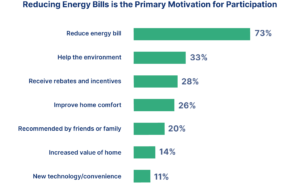
Consumers are clear about why they participate. Reducing monthly energy bills is the dominant motivation, far outweighing environmental considerations. Comfort, incentives, and practical benefits follow closely behind.
This focus on affordability is also associated with stronger overall customer experiences. According to ACSI syndicated research, customers who are enrolled in energy efficiency programs with their local utility report ACSI scores that are nearly 3% higher than those who do not.
That difference is driven in large part by perceptions of value and trust. Participants report perceived value scores nearly 6% higher and trust scores about 3% higher, suggesting that energy efficiency programs strengthen the customer relationship in ways that extend beyond bill savings alone.
This framing matters. In today’s economic climate, energy efficiency functions first as a household financial strategy. That reality strengthens, not weakens, its relevance. Programs that help customers manage immediate costs also deliver system wide value by reducing overall and peak demand. Efficiency works because it aligns private incentives with public outcomes.
A Large Share of the Market Is Still Up for Grabs

The clearest signal in the data is not current participation, but what consumers intend to do next. Among those not enrolled today, a substantial majority are either likely to participate in the near term or remain undecided. Only a small share express firm resistance.
This suggests that growth is less about persuasion and more about execution. Interest exists, but friction including unclear benefits, perceived effort, or lack of incentives appears to be slowing action. In a period when utilities and states are seeking fast, scalable ways to manage demand, reducing those frictions represents one of the most practical levers available.
What Motivates Action Is Clear and Consistent

When nonparticipants describe what would prompt them to enroll, the themes are remarkably straightforward: financial incentives, clearer information about benefits, simpler enrollment, and guidance tailored to their home.
Taken together, these responses point to a critical insight: the future success of energy efficiency depends as much on customer experience as on program design. As efficiency is increasingly treated as a system resource, clarity, simplicity, and trust become core performance requirements and not just secondary considerations.
Barriers Reflect Timing and Trust, Not Rejection

The reasons some consumers remain on the sidelines tend to be structural or situational. Some are satisfied with current energy costs. Others lack control over upgrades due to renting. A meaningful share cite trust or question whether the savings justify the effort.
These are not signs that energy efficiency has lost relevance. They point to the need for programs to continue evolving by expanding access, reducing perceived effort, and building credibility over time.
From Customer Benefit to System Strategy
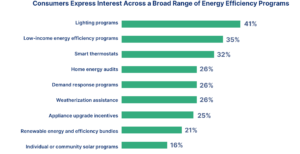
Consumer interest spans a wide range of offerings, from simple upgrades to more advanced programs that support demand flexibility. This diversity reinforces the need for balanced portfolios that combine easy entry points with deeper, longerterm savings and peak reduction.
In a high demand era, energy efficiency is no longer just about saving energy. It reduces peak strain, delays costly infrastructure investments, and helps stabilize longterm rates while delivering tangible value to customers.
The takeaway is clear: energy efficiency is already embedded in how consumers think about energy, and many more are ready to engage. When programs are financially meaningful, easy to navigate, and trusted, participation follows. In a world of rising demand and persistent cost pressure, energy efficiency is not just relevant, it is foundational.
Want to learn more about ways utilities can ensure their programs meet the needs of their customers and that friction points aren’t discouraging participation? Connect with the ACSI to explore.
Also be sure to watch for the release of our 2026 ACSI Energy Utility Study, coming next week, for new insights into how customers are evaluating their utility experiences at a time of heightened cost sensitivity, rising demand, and increased investment in infrastructure.